
Can You Lose Part of Your Inheritance in a Divorce?

Understanding excluded property and tracing after Mills v. O’Connor, 2025 BCCA 34
In British Columbia, inheritances and property owned before a relationship are generally excluded from division. But what happens when the original asset is sold, the proceeds are reinvested, and the investments later lose value? The BC Court of Appeal addressed this problem in Mills v. O’Connor, 2025 BCCA 34.
1. What is excluded property?
Under s. 85 of the Family Law Act, inheritances, certain gifts, property owned before the relationship, and property derived from these sources are excluded property and usually not divided.
Under s. 84, increases in value of excluded property during the relationship are family property.
For example, if an inherited house rises from $1 million to $1.5 million, the original $1 million is generally excluded, while the $500,000 increase is family property.
2. What did the Court decide in Mills?
The husband inherited the Bellevue Property, valued at $1,850,000. It appreciated and was sold, and proceeds were used to acquire and develop the Monck Park property. After a fire and further transactions, the Court had to determine how much of the remaining assets was still excluded. It adopted pro rata ex post facto tracing as the presumptive approach when excluded and family property contributions have become mixed.
The Mills calculation
Step 1: Identify the contributions.
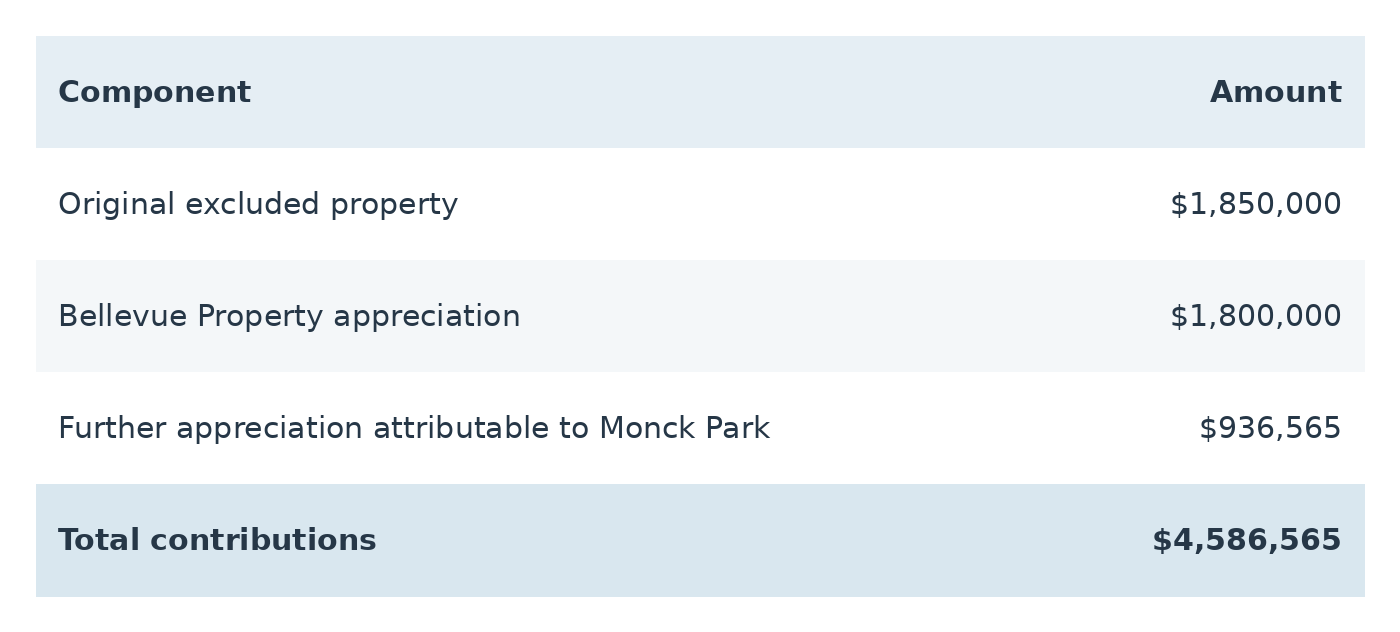
Step 2: Calculate the excluded property percentage.
$1,850,000 ÷ $4,586,565 ≈ 40.3%
Step 3: Apply the percentage to the remaining traceable property of $2,867,020.49.
$2,867,020.49 × 40.3% ≈ $1,155,409

The husband’s exclusion was therefore approximately $1.155 million, not the original $1.85 million.
The key point is that mixed excluded and family property interests share subsequent losses proportionately.
3. What if the property falls, rises, and falls again?
Consider a hypothetical: a spouse starts the relationship owning a $2 million house. It declines in value and is sold for $1 million. Use the proceeds to buy a cottage which appreciates to $4 million and is sold. The $4 million is invested in stocks but the investments are worth only $2 million when valued for division.
The cottage example: step-by-step
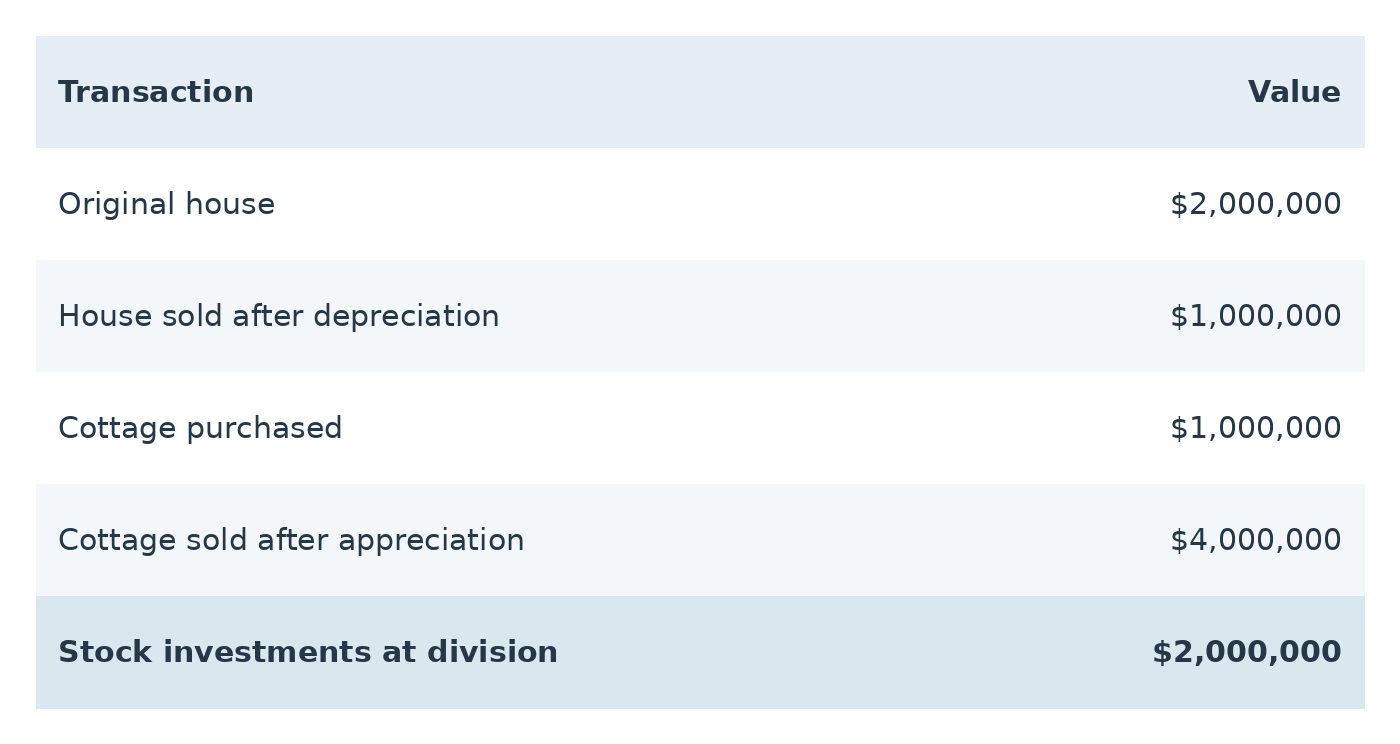
Step 1: Compare the original excluded contribution with the subsequent $3 million cottage appreciation.
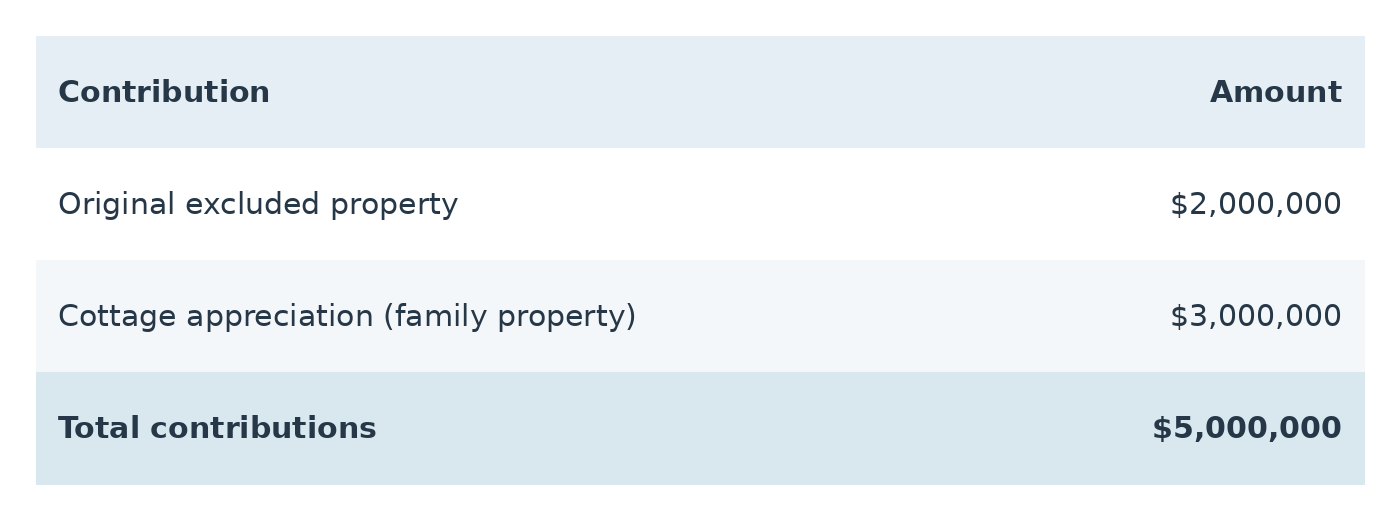
Step 2: Determine the excluded proportion.
$2,000,000 ÷ $5,000,000 = 40%
Step 3: Apply that proportion to the remaining $2 million investments.
$2,000,000 × 40% = $800,000

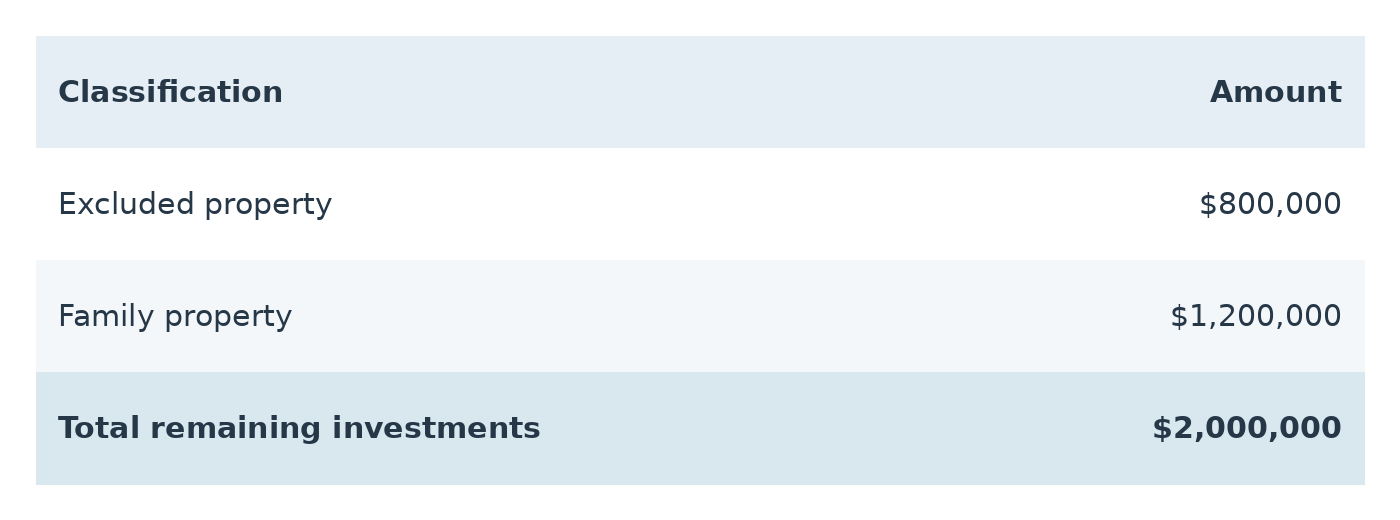
If family property is divided equally, each spouse receives $600,000 of the family portion. The original owner receives $800,000 excluded plus $600,000 family property, for $1.4 million in total; the other spouse receives $600,000.
$1,200,000 ÷ 2 = $600,000
$800,000 + $600,000 = $1,400,000
Why does the calculation use the original $2 million even though the house sold for $1 million? This particular illustration compares the original excluded contribution with later family-property appreciation, rather than separately deducting the initial loss.
It is a hypothetical application discussed in commentary on Mills, not a result the Court decided on these facts.
4. What did Mills leave open? Other tracing methods
The Court described pro rata ex post facto tracing as presumptive, not mandatory in every case. It left room for a different approach where the facts and evidence justify it (see Mills, paras. 88–99).
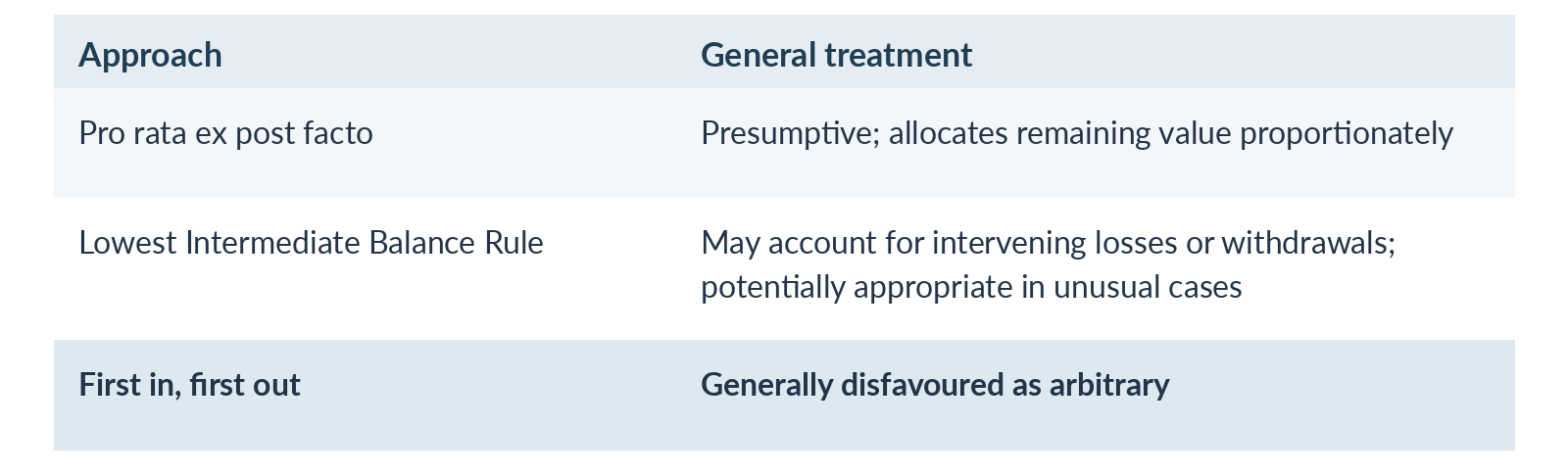
The Lowest Intermediate Balance Rule may be argued where successive transactions and intermediate losses make a simple proportional allocation unfair, but it is not automatically available or necessarily preferable. The Court did not provide a comprehensive test for choosing an alternative.
The treatment of borrowing, mortgage refinancing, and the timing of appreciation or depreciation may also require further judicial clarification.
5. What does this mean for separating spouses?
Selling or reinvesting an inheritance does not automatically eliminate the exclusion. But tracing the money into a replacement asset does not guarantee recovery of the original dollar amount. Records of original values, sale proceeds, purchases, refinancing, and investment transactions are crucial. Where the proportional method produces an unusual result, the evidence may support an argument for another tracing approach.
The cottage example is illustrative; outcomes depend on the facts and the tracing method the court accepts.
This article provides general legal information about British Columbia family law and is not legal advice. The outcome of any case depends on its particular facts and financial evidence.