
Your Corporation Makes a Profit, But Where Does the Money Go?

Intercompany Loans, Corporate Debt, and Capital Reserves and Impact on Child and Spousal Support
You own three corporations:
Corporation A: The Operating Company. Your main business earns $500,000 in annual pre-tax profit.
Corporation B: The Real Estate Holding Company. It owns a commercial building and must meet mortgage obligations.
Corporation C: The Second Operating Company. A newer restaurant or retail business is operating at a loss and needs funding.
Corporation A transfers $80,000 to Corporation B for mortgage obligations and $40,000 to Corporation C to cover operating losses. When the owner separates, should the full $500,000 be treated as income available for child or spousal support? Not necessarily.
1. Corporate Profit, Cash, and Guideline Income Are Different
Corporate profit is the amount shown as earnings in the financial statements. It does not necessarily equal cash in the bank. A corporation may use cash to repay loan principal or advance money to another corporation without recording those payments as expenses on its income statement.
Guideline income is the amount determined for child or spousal support purposes under the applicable legal framework. Under section 18 of the Federal Child Support Guidelines, a court may include all or part of a corporation’s pre-tax income when assessing a shareholder’s income. The court considers the business circumstances rather than automatically treating all corporate profit as personal income.
Importantly, transferring $120,000 from Corporation A does not automatically reduce support income from $500,000 to $380,000. The court must examine the purpose of the transfers, the finances of the related companies, and whether amounts have already been counted elsewhere. Personal income and other applicable adjustments must also be considered.
2. Necessary Payments Versus Discretionary Loans
In McKenzie v. McKenzie, 2014 BCCA 381, the BC Court of Appeal distinguished discretionary corporate advances from required business obligations. Advances used for purposes such as a condominium for the shareholder, a family-member loan, and other investments were not shown to be necessary to sustain the business and were not excluded from income available for support.
The Court treated ordinary, mandatory mortgage principal payments on longstanding business-related real estate differently. Those payments were necessary to sustain the corporation and could be recognized when assessing available income. The court did not require the business to refinance simply to increase funds available for support.
3. A.R.J.: Debt Payments May Be Unavailable for Support
In A.R.J. v. Z.S.H., 2021 BCSC 274, a surgeon operated through a medical corporation and a related real estate holding company. The court accepted that ordinary principal repayments on long-term corporate debt were necessary to sustain the companies and excluded those amounts from income available for child support.
This matters because mortgage interest is generally recorded as an expense, while principal repayments reduce debt and generally do not reduce accounting profit. A company can therefore show a profit while using cash to meet mandatory principal payments.
4. Evanow: Reasonable Capital Reserves
In Evanow v. Lannon, 2018 BCCA 208, the BC Court of Appeal considered corporate funds retained for capital requirements. A reasonable, supported capital reserve may be relevant to available income, but a shareholder cannot simply label profits as needed for future expenses without evidence. The court accepted an annual reserve of approximately $64,000 rather than the approximately $128,000 sought.
5. How Is Support Income Actually Calculated?
The following example shows why the company’s reported profit is not automatically the owner’s guideline income:
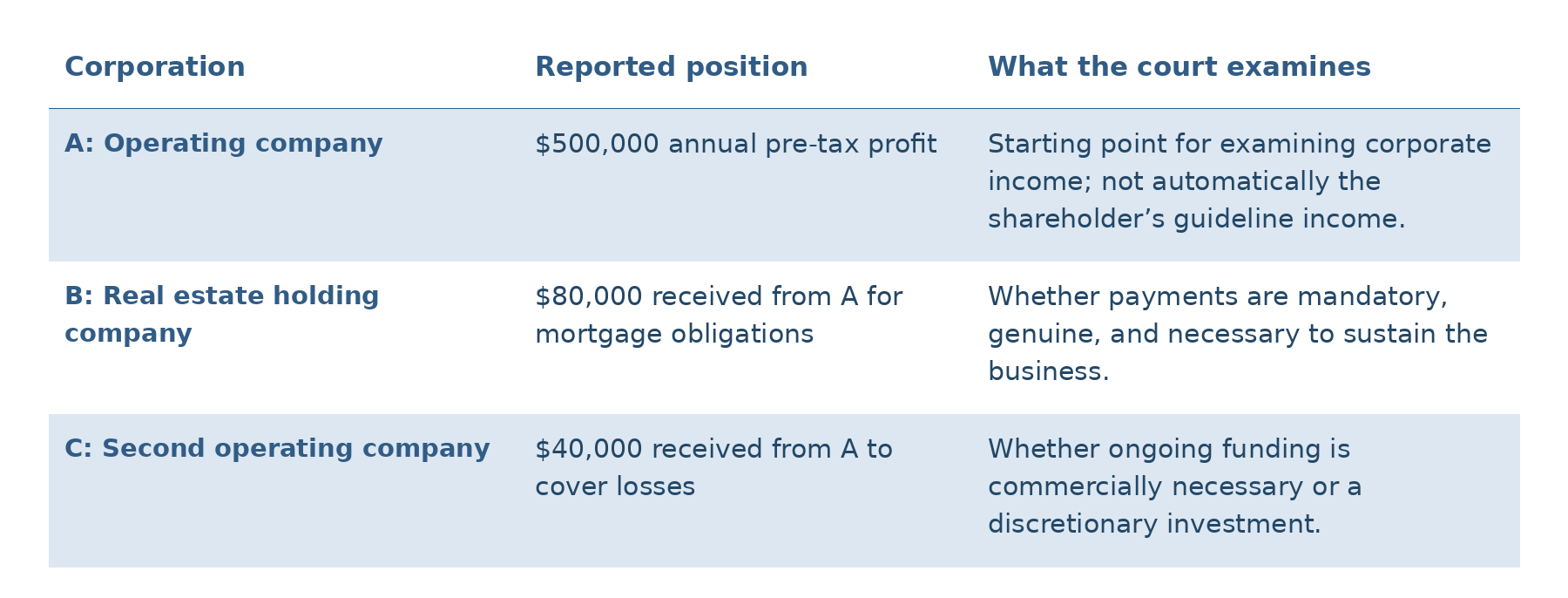
Corporation A has transferred $120,000, but guideline income is not automatically $500,000 minus $120,000 = $380,000. The court considers the corporate group’s financial evidence and determines what income should properly be attributed to the shareholder.
The onus is on the business owner seeking an adjustment to establish that the claimed payments or reserves are reasonably required. The court may allow some adjustments, reject others, and must avoid double-counting intercompany transfers.
6. Who Must Prove the Money Is Unavailable?
The onus is on the business owner who says corporate income is unavailable for support.
Corporate profit, cash flow, and guideline income are not interchangeable. The $500,000 profit is an important starting point, but the $120,000 transferred to related companies is not an automatic deduction. The business owner seeking an adjustment must prove, with clear financial evidence, that the payments or reserves are legitimate business requirements and that the funds are not reasonably available for support.
Need Advice About Corporate Income and Support?
When a business owner operates multiple corporations, determining income for support can be complex. Our family law team assists with corporate income, intercompany loans, holding companies, business debt, and capital reserves. Contact our office to discuss how these issues may affect child or spousal support.
This article provides general legal information and does not constitute legal advice.