
Caught on Tape: Can You Secretly Record Your Spouse and Use It in Family Court?
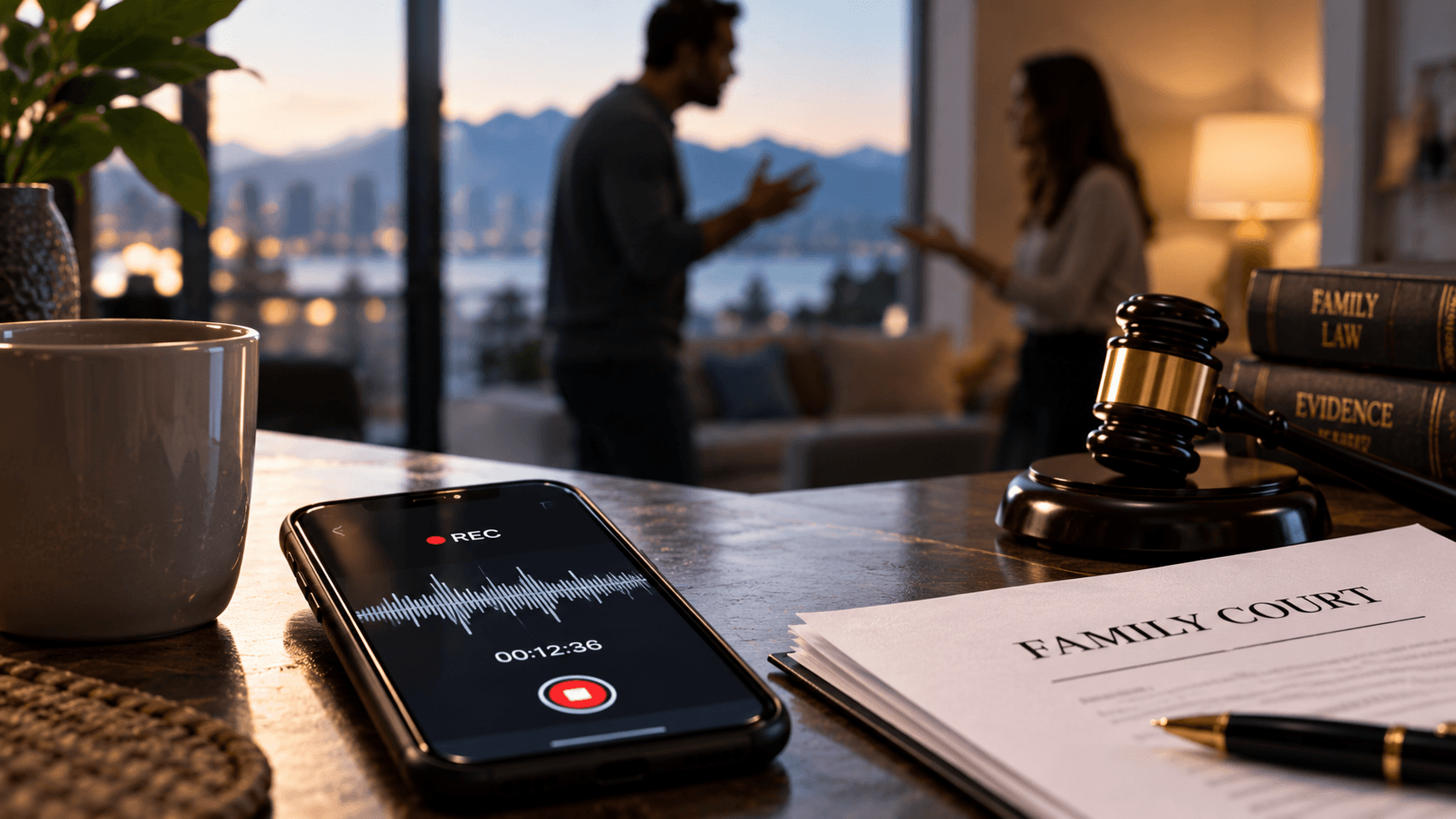
When Secret Recordings Can Help or Hurt Your Case
You are going through a difficult separation. Your spouse makes threats, denies previous conversations or behaves aggressively when no one else is around.
You secretly record your conversations, believing they will help prove your case in court.
But will a judge accept the recordings or Could they actually hurt your case?
In British Columbia, secretly recording your spouse may be legal, but that does not mean the recordings will be admitted in court or if they do, given any weight.
1. Is It Legal to Secretly Record Your Spouse?
Under section 184(2)(a) of Canada's Criminal Code, it is generally lawful to record a private conversation if you are one of the participants. This is commonly known as the one-party consent rule.
However, secretly recording conversations between your spouse and others, when you are not participating and no participant has consented, is illegal under the Criminal Code.
The important distinction is that a lawful recording is not necessarily admissible in family court.
2. Why Have Courts Called Secret Recordings an "Odious Practice"?
In Seddon v. Seddon, 1994 CanLII 3335 (BC SC), the court strongly criticized secretly recording conversations between family members, describing it as:
"This is an odious practice."
The concern is particularly significant in parenting disputes, where secret recordings may undermine trust, escalate conflict and interfere with the parents' ability to cooparent.
3. What Is the Legal Test for Admitting Secret Recordings?
In Finch v. Finch, 2014 BCSC 653, the court identified a four part test for determining whether a secret recording should be admitted at trial:
Relevance: Is the recording relevant to an issue before the court?
Identification: Are the participants accurately identified?
Trustworthiness: Is the recording authentic and reliable?
Probative Value vs. Prejudice: Does the recording's evidentiary value outweigh its potential prejudicial effect?
Even if admitted, the recording's reliability and surrounding circumstances may affect how much weight the judge gives it.
4. What If the Recording Was Staged or Taken Out of Context?
In Lam v. Chiu, 2012 BCSC 440, the court stated:
"The recording was staged and therefore unfair."
Although the recording was admitted, the court recognized concerns about how it had been created.
For example, one spouse may secretly start recording, deliberately provoke an argument and then capture the other spouse's angry reaction without recording the events leading up to it.
A recording may therefore capture what someone said without providing a fair account of what happened.
5. When Will a Court Refuse to Admit a Recording?
Family courts have cautioned against secret recordings because they can increase mistrust, escalate conflict and undermine the cooperation necessary for effective co-parenting.
In Van Ruyven v. Van Ruyven, 2021 ONSC 5963, the Ontario Superior Court emphasized that parents should not feel as though their every conversation is being monitored or recorded for future litigation. The court warned that routinely admitting such recordings could encourage surveillance between parents rather than promote trust and cooperation. The judge excluded the recordings and ordered that neither parent record the other without consent.
In Tillger v. Tillger, 2019 ONSC 1463, the Ontario Superior Court identified the dangers of recordings that are selective, edited, taken out of context or deliberately provoked. The court excluded several recordings and gave little weight to others because of concerns about their reliability.
British Columbia courts have taken a similar approach. In Dhillon v. Dhillon, 2019 BCCA 163, the BC Court of Appeal upheld the trial judge's decision not to admit or consider a secretly recorded conversation because it was considered untrustworthy. Only one party knew the conversation was being recorded, and the recording began partway through the discussion.
These decisions illustrate that family courts are concerned not only with what a recording captures, but also with how it was obtained and its impact on the family dynamics and coparenting relationship.
The concern is simple: Parenting requires communication and cooperation. Encouraging parents to secretly record one another can undermine the very trust courts seek to preserve, particularly where children are involved.
However, recordings that disclose serious misconduct, family violence or risks to a child's safety may justify a different approach.
The Bottom Line: Think Before You Press Record
Secret recordings can sometimes provide important evidence, particularly where threats, family violence or children's safety are involved.
However, in parenting disputes, secretly recording family members may also raise concerns about the conduct of the person making the recordings.
The fact that you can legally record your spouse does not necessarily mean you should.
Need Advice About Evidence in a Family Law Dispute?
If you are involved in a separation, divorce or parenting dispute and have questions about using recordings, text messages or other electronic communications in court, contact our family law team to discuss your circumstances.
This article provides general legal information and is not a substitute for legal advice.